Token Economics in Enterprise AI: How Usage Costs Are Reshaping AI GTM
AI usage is no longer theoretical inside enterprises.
Employees are using coding assistants, support agents, sales copilots, research tools, internal knowledge bots, meeting summarizers, workflow agents, and content generators.
So what happens when usage scales?
Unlike traditional SaaS, AI does not just monetize access to software. AI monetizes work. Every prompt, generated answer, code edit, agent step, document analysis, or support resolution consumes compute. That compute usually shows up as tokens, model calls, inference time, or credits.
This means enterprise AI has a different cost structure from the SaaS market we are used to.
In traditional SaaS, high adoption is almost always good news. In AI, high adoption is only good news if the value created grows faster than the cost of running the AI.
That is why token economics is becoming one of the most important, least understood forces shaping the next phase of enterprise AI.
The AI ecosystem and where cost is generated
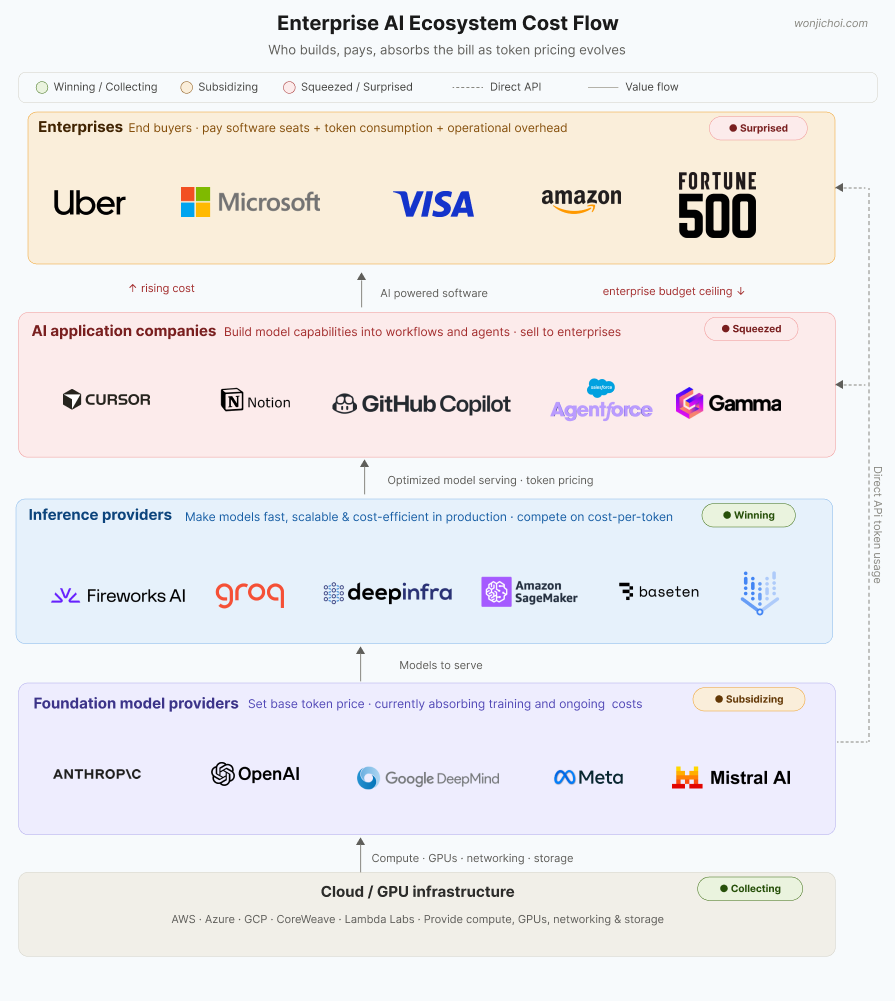
The enterprise AI stack has five distinct layers, and cost flows through all of them differently.
| Layer | Who they are | Role in the cost structure | Current position |
|---|---|---|---|
| Foundation model providers | Anthropic, OpenAI, Google DeepMind | Set the base token price; absorb training and infrastructure cost upfront | Subsidizing Subsidizing usage to build market share; beginning to reverse that |
| Inference providers | NVIDIA, AWS, Azure, Together AI, Groq | Make models fast and scalable in production; compete on cost-per-token at the infrastructure layer | Winning Capex investment paying off as demand accelerates |
| AI application companies | Notion, Glean, Cursor, Salesforce AI, vertical SaaS with AI features | Package model capabilities into workflows; some absorb usage costs and resell as product value | Squeezed Margin pressure from both model providers and enterprise budget ceilings |
| Enterprises | Fortune 500s, scaling tech companies, public sector | End buyers; pay for software seats, token consumption, and operational overhead | Surprised Most are discovering true AI costs don't match original budgets |
| Cloud / GPU infrastructure | AWS, Azure, GCP, CoreWeave, Lambda Labs | Provide compute, GPUs, networking, and storage; the physical substrate the entire stack runs on | Collecting Hyperscaler AI capex projected at $527B in 2026 |
Enterprise AI ecosystem: five layers, who each is, their role in the cost chain, and their current position as token pricing resets.
For most of the past two years, foundation model providers were effectively subsidizing enterprise access.
Flat-rate pricing with unlimited AI usage for a fixed monthly fee was not economically sustainable at the usage rates that agentic AI is now generating. One documented user consumed 10 billion tokens over eight months on a $100/month plan. At actual API rates, that session would have cost approximately $15,000. The gap between what enterprises paid and what usage actually cost was absorbed somewhere. Sometimes it's passed to the customer through usage-based pricing. Sometimes it's hidden inside an enterprise bundle. Sometimes the vendor charges based on outcomes instead of tokens. But the underlying cost is real, and things are starting to tighten.
But the underlying cost is real and things are starting to tighten.
What’s changing/happening now
Providers are repricing
Anthropic has moved away from flat-rate enterprise contracts toward per-seat pricing with token consumption billed on top at API rates. OpenAI's Sam Altman described the direction plainly: "We see a future where intelligence is a utility, like electricity or water, and people buy it from us on a meter." The subsidized era was a customer acquisition strategy, not a business model.
Agentic AI breaks cost assumption made on single-turn usage
A chatbot might answer once. An agent can plan, search, retrieve context, call tools, inspect outputs, retry, evaluate, and then produce a final answer. One user action can trigger many model calls behind the scenes. Goldman Sachs projects this behavioral shift alone will drive a 24x increase in global token consumption between 2026 and 2030. Per-unit cost deflation doesn't matter if volume grows by an order of magnitude.
Usage is being measured, but value is not (or harder to measure)
The current enterprise AI conversation still over-indexes on usage. Uber ran internal leaderboards ranking teams by total AI tool usage, an incentive structure that rewarded token consumption, not business outcomes. High engagement scores are not the same as high ROI. Most enterprises have no mechanism to connect the two, which means they can't make rational decisions about where to spend and where to cut. Concerns about wasted spend are rising.
What could happen over the next years
Token economics will not stop enterprise AI adoption .But it will reshape how the market is structured, bought, and sold.
Cost of using AI (token prices) might continue to increase
The assumption that token costs will naturally normalize is built on the subsidized pricing era. As model providers face IPO pressure and move to usage-based billing that reflects true costs, enterprise budgets are being reset against a very different baseline.
Token governance becomes a new enterprise discipline (or become sales enablement)
Just as cloud computing created the need for cloud cost management, AI will create the need for token and inference governance. CTOs will want visibility into token sprawl across teams, tools, and workflows for the ability to control it before the invoice arrives. Think of it as AI FinOps.
AI Platform consolidation accelerates
Enterprises managing five different AI tools, each with its own token economy, usage cap, and billing model, will consolidate onto fewer platforms that offer cross-tool cost visibility, governance controls, and negotiated volume pricing. The winner here isn't the most capable model. It's the most legible cost structure.
Model routing becomes a more important operating practice
Not every workflow needs a frontier model. Some tasks require deep reasoning but there are jobs that cheaper models can handle, such as extraction, classification, summarization, or formatting. One of the easiest ways to waste money is to use the most expensive model for everything, and smart organizations will stop doing it.
Enterprise pricing shift. Could Outcome-based and capacity-based pricing replace pure token billing?
Most enterprise buyers don’t want to buy tokens. They want resolved tickets, completed workflows, reviewed contracts, generated reports, qualified leads, or shipped code. The tension is structural: enterprise buyers want AI priced like SaaS, while AI vendors have cost structures that increasingly look like cloud infrastructure. The likely resolution is hybrid pricing with predictable packaging on the outside and usage optimization on the inside.
What this means for Enterprise AI Market and GTM
Inference efficiency will become a GTM advantage. And Pricing model is now a competitive differentiator. The strongest enterprise AI companies will likely offer predictable packaging on the outside and sophisticated token optimization on the inside
ROI framing has to get specific. AI ROI needs to be tied to specific business outcomes
The application layer is in the most difficult position. AI application companies packaging foundation model capabilities into enterprise workflows are in the most structurally difficult position. Token costs from upstream providers are rising as subsidies end. Enterprise budget tolerance is not rising proportionally. The middle gets squeezed. The companies that survive this will be those with proprietary data advantages, deep workflow integration that creates switching costs, or their own inference efficiency that reduces API dependency.
Be prepared for shifting buying criteria. The vendors that build cost governance tools and outcome measurement into their products as a core feature could win the next enterprise buying cycle.
A new category is forming around AI cost architecture. In the early internet era, companies solved rising bandwidth costs by building a smarter delivery layer on top. CDNs routed content more efficiently so the underlying cost stopped scaling with demand. The same thing is happening in AI right now. A new layer of tooling is emerging that helps enterprises route the right tasks to the right models, cache repeated queries, and track where tokens are actually going. Enterprises will either build this capability internally or buy it. Either way, it's becoming a necessary part of running AI at scale.
As cost continues to increase while usage scale, the enterprises and vendors that move early on AI cost architecture will have a durable operational advantage.